Monday, March 7, 2016

RIP Paul Ryan

Paul Ryan, comic book artist and cartoonist, died yesterday at the age of only 66. As a dedicated fan of 90’s comics, especially those that flew somewhat under the radar, this is really sad news. A veteran who contributed lasting work across three decades, it’s a shame that Ryan’s name is not particularly well known, even to comic book fans. Originally Iron Man artist Bob Layton’s assistant, Ryan moved on to penciling work at Marvel, taking over the art duties on Iron Man and the Squadron Supreme, and co-creating the series DP7 for Marvel’s New Universe. Perhaps his most famous single issue is Amazing Spider-Man Annual #21, aka the wedding issue.


Spider-Man Annual 21 1987 Paul Ryan wedding

 Ryan began the 90’s working on the Avengers comic at a time when the book was struggling to find consistency or much in the way of sales success, but was pulled from it in order to work with then Editor-in-Chief Tom DeFalco on Fantastic Four, where he’d work for the next four years. In the wake of Walt Simonson’s incredible, boundary-pushing work, De Falco and Ryan focused more on the soap opera aspect, a decision that played to Ryan’s strengths at conveying emotion and character in his art. Perhaps most infamously, Ryan designed Sue’s “invisible cleavage” 90’s outfit, notable for a four logo being cut out, along with various other missing strips of fabric along her legs and arms. In some ways it was a response to the “bad girl” trend, but it seemed less extreme in the context of the story, where Sue was behaving more recklessly over time due to the slowly returning “Malice” entity from John Byrne’s run.
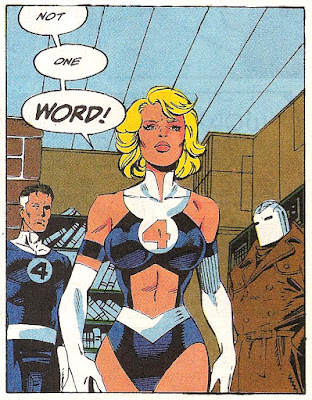
Invisible Woman 90's Costume Invisible cleavage Paul Ryan


After Ryan left the title just before the Heroes Reborn event, he became a freelancer, working on Superman: the Wedding Album and Flash. He returned at the tail end of the 90’s as part of the MC2 line, where he’d be reunited with DeFalco. In 2005, Ryan, the former artist of the Spider-Man newspaper strip, was chosen as the daily artist for the Phantom strip, a job he’d hold until his death. In addition, he spent several years illustrating the Sunday strip.

Paul Ryan Ant Man Trading Card Series 3


That Ryan isn’t particularly well-known, even among comic book fans, is not correlated to his talent as a storyteller. Not particularly flashy, Ryan, along with relative contemporary Ron Frenz, was a sort of throwback to an earlier era of clean lines and strong anatomy at a time not particularly known for either. That ability to draw simple, clean characters helped Ryan become one of Marvel’s most prolific trading card artists.

Paul Ryan Art Avengers Poster


A fan of the industry since childhood, Ryan was fortunate enough to make his living drawing. His contributions, even of the invisible cleavage variety, should not be forgotten.

Wednesday, January 13, 2016

I Knew There Was a Reason I Didn't Trust That Baby

Sorry to followers of this blog, I haven't had the time to update even on a slightly reduced schedule. I just don't have the time for humorous and insightful comics reviews at the moment, as I am somehow able to write as a full-time job. But I do have time to read great 90's comics and then screencap them:

Suprema Evil Baby Alan Moore Jim Mooney
Via Supreme 52-A, Alan Moore and Jim Mooney

Saturday, September 5, 2015

Review: Web of Spider-Man #129

Web of Spider-Man #129, "Time Bomb Pt. 2: By My Hand, Mary Jane Must Die!"
Written by Tom DeFalco (plot) and Todd DeZago (script), Penciled by Steven Butler, Inked/finished by Randy Emberlin

Web of Spider-Man 129 Cover


In the podcast I appear in, I had some negative things to say about "Spider-Man: The Clone Saga," a bizarre late 2000s miniseries written by Howard Mackie and DeFalco in an attempt to tell a condensed, "true to the original concept" clone saga story. In short, it's a bizarre mish-mash that chickens out about absolutely everything and is full of incredibly awkward dialogue and revives evil Harry Osborn for no reason. I'm not going to tell you the clone saga is great (it wasn't, by and large), but it did have genuine pathos when, say, Doctor Octopus saves Spider-Man's life and willingly surrenders, expecting to face Spidey next time only to be murdered by Kaine. Or Aunt May's legitimately great death issue that got rid of a character that hadn't been particularly useful in about 15 years in a touching, heartfelt way (later crapped on by John Byrne at his dirt-worst). But I'm not here to review those issues! I'm returning to Web of Spider-Man!

Tuesday, August 4, 2015

Robin #19

Robin 19, “War Gods in the Hood,” Cover Date August 1995
Written by Chuck Dixon, Pencils by Mike Wieringo, Inks by Stan Woch

Robin 19 Cover Julie Caesar Ulysses General


Tim Drake, aka Robin #3, is the Robin I grew up with as a kid in the 90’s. After the disaster that was the Jason Todd death, Tim Drake was created to be a smart, dedicated hero in his own right that wouldn’t be resented by fans for “stealing” Dick Grayson’s job the way Todd was. Early writers of the character, primarily Chuck Dixon, really focused on the “detective” aspect of the character. It’s easy to blame Batman’s sidekick getting his own series as some sort of early 90’s cash-grab, but the early Robin books tend to be consistently very good. All written by Chuck Dixon, who handled the mini-series and first 100 issues of the solo series, the books also benefitted from solid art from veterans like Tom Lyle and Tom Grummett. In the book’s second year, Mike Wieringo took over as the book’s regular penciler, and here we are!

Saturday, July 25, 2015

Rant: Give Artists Credit

Comics Beat posted an interesting article a few days ago about the importance of the artist in selling a comic. Incredibly, only 5% of retailers credited the artist as the most important thing in terms of selling a comic. I understand there's market forces at work there; comic book retailers have taken on the near-insane task of selling comic books, so their ideas are necessarily skewed by the need to "feed their family" and other similar considerations.

As someone who is entering the "comic book podcast" arena only a handful of years after most, I've already noticed that the two episodes that have gotten the most downloads thus far are the two with work by Grant Morrison and Alan Moore, two "names," that, not coincidentally, are not comic book artists. Not to pick on my co-hosts, but I cringe when introducing an episode by saying "Alan Moore's The Killing Joke," or similar pronouncements (although to be fair, in that episode we did explain that the story is really Brian Bolland's project more than Moore's).

The thing is, this mind-set is both backwards and toxic. Art is the most important thing in comic books. Period. It is the defining point of separation between comics and its bookstore neighbors in the sci-fi section.

Wednesday, July 15, 2015

Review: X-Force #46

X-Force #46, “Behind Closed Doors,” Cover Date September, 1995
Written by Jeph Loeb, Penciled by Adam Pollina, Inked by Mark Pennington

X-Force 46 Cover Sunfire Mimic


Most people on the outside looking in at X-Force see it as proof of 90’s excess: it was Rob Liefeld’s pet project, the book that set all sorts of speculator records before being overshadowed by Jim Lee’s X-Men #1. Despite not having its own media presence, there was a line of action figures featuring endless variations of Cable, the team’s gun-toting mystery-man. While it’s true that the book as drawn and plotted by Rob Liefeld was the sort of big, bombastic action you’d expect from a book called “X-Force,” what a lot of people may not remember is that Liefeld’s tenure on the title was exceptionally brief.

X-Force had begun life as the New Mutants, the mid-80’s teen group created when Jim Shooter noticed that there were basically no more teens on the X-Men title (except Kitty), and while the team’s roster had changed in the wake of Cable taking over as leader, these were still characters that had existed in some form for several years. As I mentioned in my New Warriors review, I am a sucker for “teens growing up” stories, and X-Force is no exception. Personally, I found the leader-less “wandering around” phase far more interesting than the military strike team. So let’s get into it!

Friday, July 3, 2015

Review: New Warriors #22

New Warriors #22, "The Stolen Children, Nothing But the Truth Part 1" Cover Date April 1992
Written by Fabian Nicieza, Penciled by Mark Bagley, Inked by Larry Mahlstedt

New Warriors 22 Cover


I should preface this review by mentioning that I can't really be objective in my appreciation of the New Warriors. As I mentioned in a previous post, they were the first comic I read that I didn't learn about from TV, and I found the characters, who ranged from high school kids to college students to be pretty much the coolest. I know now that they're more or less Marvel's answer to the Teen Titans, but I love watching characters grow up, and that was the best part of the original series. It was also cool that I felt like I could follow all of the character's appearances, since they rarely popped up in other books. Of course, after years of growth, culminating in Justice and Firestar being added to the Avengers at the height of its resurgence in popularity, somebody at Marvel hit the reset button because the rest of the world wasn't aging, and things have been a bit dire for the team for the past 15 years or so as writers either play up nostalgia or take things in bizarre new directions. But taken on its own, Fabe and Bagley, two nearly unknowns at the time, managed to show everyone how good they could be and told a great, underrated story. Their run is available in hardcover if that's your thing, containing two years of the ongoing series, plus annuals and crossovers. Unfortunately, the book is not available on Marvel Unlimited.