Wednesday, December 21, 2016

Stormwatch #1, Original Cover Date March 1993
Story/Script by Jim Lee and Brandon Choi, Penciled by Scott Clark, Inked by Trevor Scott

I think I’m pretty open-minded when it comes to 90’s comics. I’ve really tried to emphasize that the 90’s were not all gigantic guns and weirdly proportioned women gritting their teeth at one another. That said, that’s exactly what Stormwatch #1 is. It’s everything you associate with an early 90’s X-Men comic except it replaces the characters you know and like with poorly designed doppelgangers!

We begin with Battalion, the aging, gun-toting, African-American leader of the Stormwatch as he leads his strike team of Fiji the even-keeled Japanese muscleman, Diva, the hot chick, Hellstrike, and Winter (I don’t know anything about these guys, they each get about one line). They are on assignment in Sarajevo to rescue an old friend of Battalion who is trying to get a school bus full of genetically important children to safety. The bus is attacked by the “Mercs,” an evil Brotherhood-like team led by Deathstroke the Terminator, I mean… Deathtrap. Let me guess, he's named “Blade” Wilson? Deathtrap is joined by Slayer, Razer, and Kilgore, with Kilgore as the Wolverine/Sabretooth type. Slayer and Diva square off, and we learn that Slayer was a good guy and that she talks like Rogue. I am not exaggerating. “I’ve become an exceptional cold-blooded killa, sugah.” Mid-fight, another Merc appears, a spikey-shoulderpad wearing guy that looks like minor villain “Ahab.” The mission goes well-enough, except Battalion’s friend gets murdered by Deathtrap.

Battalion wakes up in New York, re-living the events of the battle, when his mom comes in to tell him someone’s at the door. Synergy, a Stormwatch employee and former rival, is there with some government goons. Battalion’s brother Malcolm was arrested for robbery, but his diplomatic immunity gets him off the hook. Battalion listens to his brother’s insane story of his arrest, featuring pony-tailed white men breaking into an electronics shop for zero reason and carrying off televisions. Malcolm doesn’t actually take anything, but he runs off with his pals. When the police arrive, his pony-tailed idiot friend produces a gun and tries to shoot the cops, but gets shot to death for his trouble. The officer, having shot the kid to death, has his gun drawn on the unarmed teen and shouts “Don’t make me do it, son!” Which I mean, good for him for not shooting an unarmed teen for standing too close to an armed white guy! I feel like that would have been a bad thing to do! Battalion calls his brother Malcolm “boy” and lectures him for being a disappointment.

The next day, Battalion and his family are at his friend’s funeral, when who should appear but the Mercs. They start blasting everywhere, and Malcolm gets shot. Synergy checks on him and finds he’s completely unhurt. But that means… Battalion is forced to let Synergy “activate” his brother’s potential powers, causing pink optic blasts to shoot out of Malcolm. To be continued!

Review:

Let me start by saying some nice things. Scott Clark (RIP) has some nice pencils. He’s not a superstar artist, and I think he may be tracing Jim Lee or some other contemporary artists on some of this, but overall his linework is clear and solid. Malibu’s vaunted coloring process is on display as the coloring is pretty good.

On the other hand, the first fight scene is staged incomprehensibly. I don’t know how much design work he put into these characters, but they all feel like below-average Lee/Liefeld action figures, and I say that as someone who had action figures of Gideon and other Externals. The plot is pretty much a train-wreck from jump-street, built around two confrontations with the blankest slate bad guys, mercenaries creatively called the Mercs. This is also a first issue that doesn’t introduce much in the way of character, setting, or anything else, devoted as it is to confusing fight scenes where new, unnamed characters appear halfway through. As alluded to, the rest of the team doesn’t ever talk to Battalion, who isn’t particularly sympathetic as he lectures his brother for having loser friends. The whole Malcolm scene is completely ridiculous, with Malcolm inexplicably getting caught up in the worst-planned theft in history. Typical NYPD cops though, talking about how they were going to charge him with “robbery,” even though it was clearly theft. Why is Malcolm associating with these clowns? Why are the heroes so flat-footed when the Mercs show up at the funeral? How did the mission even end, since we cut out that part? Why does Deadshot re-use essentially the same line about how he should have killed Battalion in Kuwait both times he sees the guy?

90’s Fashion: so much! Battalion’s costume is full of pouches, electronic doo-dads, and huge shoulder pads. Diva wears a Psylocke-style one-piece with knee-high boots, complete with spikes going around her thigh, and a pouch-belt around her waist. Winter wears a jacket over his bodysuit. Deathtrap has even more pouches, and an over-one-shoulder bandolier. Slayer, another member of the Mercs, is just wearing one of Magneto’s acolyte costumes she found lying around. Synergy wears a short red dress with a big blue jacket over it to Battalion’s home. Stoney, one of Malcolm’s pals, has a long, stringy ponytail. One of the Bosnian(?) schoolchildren is wearing an Image t-shirt.

Saturday, April 16, 2016

Arc Review: Fantastic Four, Unthinkable

In a previous post, I talked about how I didn’t share in the relatively common sentiment that J. Michael Straczynski’s take on Spider-Man was a sort of Renaissance, ruined only by editorial marriage-meddling, organic web meddling, Civil War meddling, and “Gwen Stacy secretly had Norman Osborn’s kids” meddling. In my review of the “Spider Totem” arc, I think I explained why JMS’s work didn’t do it for me, even coming after a truly dire run by John Byrne and Howard Mackie.

I bring this up because recently in my Fantastic Four re-read I’ve reached Mark Waid and Mike Wieringo’s celebrated run on the book, and while I enjoyed the first arc quite a bit, I found their much-touted “Unthinkable” arc to be… not good comics. Which stinks, because I love Ringo’s art and Waid can be one of the best comic writers in the business when he’s on; I have no vested interest in disliking a story made by creators I like. The story, for those unfamiliar with it, is that Doom, tired of his failures(???), embraces magic, sacrificing his teenage love Valeria in order to gain new mystical powers, which he then uses to capture the Fantastic Four and torture Franklin Richards by sending him to, as the comic puts it, “hell.” This is controversial to some fans, as apparently there’s a sentiment that this goes against Doom’s characterization as made famous by John Byrne and others, but the general consensus is that the vileness of Doom’s actions makes this a more memorable story. In 2011, it was ranked the #11 Dr. Doom story by Comic Book Resources.

I have quite a few problems with this story, so I’ll go over them one at a time. My first issue is: why does Dr. Doom feeling like he’s a loser? The idea of the story appears to be that Doom is tired of losing to Reed Richards, but that characterization doesn’t really make any sense. It’s the perception of Doom impotently shouting “RICHARDS” in Wizard magazine given form in a comic when it doesn’t reflect the comic’s reality. In Doom’s last appearance in FF, he’d successfully delivered Valeria, naming the child and one-upping Reed, who had failed to save Sue’s second child in one of Byrne’s best issues. So in his last appearance, he wasn’t “defeated” at all- he totally won. He's also the head of a small but important country. Before his latest appearance, he showed up at earth’s doorstep with an invading army after successfully conquering Counter-Earth. On earth, he rules a small country that he’s managed to keep independent from either Western or Eastern or Middle-Eastern powers, and he’s got diplomatic immunity: his previous story appearance prior to Unthinkable featured him offering asylum to the Inhumans. But for the purposes of this story, he feels like science isn’t working, and chooses magic, in what is a perfectly good prologue issue that doesn’t feature the FF at all. I’m fine with this issue showcasing Doom, and there’s a nice little fake-out that might surprise new readers, as Doom ups his magical powers at the cost of personal happiness.

So what does Doom want to do with these new powers? Humiliate Reed Richards, I guess? Now you can argue that Doom’s acted this way before, carrying petty grudges against the team, but there doesn’t seem to be any reason for Doom’s actions in the story beyond “Grr I hate Reed Richards.” But worse than his motivation is his execution, my second issue with this arc: Doom targets the family through their children, possessing Valeria, and mystically sending Franklin into “hell,” where he is tortured, presumably for hours if not days, by demons. Just so we’re clear, Franklin is 6-7 years old in this story. I get it, Doom’s the bad guy, but this is pretty bizarre stuff from the character, and seems to exist only to show that “this ain’t your daddy’s Dr. Doom!” It’s poor characterization that only makes sense from the outside looking in, trying to show that Dr. Doom isn’t just going to tie up the heroes and force them to dress as Blackbeard any more.

In the story, Doom then fights the team, whose “this time, it’s personal” response to their children being attacked is to bring guns. Also, Ben snaps Doom’s neck. But of course, since Doom is magic now, he Linda Blair’s his head back and captures the heroes. Except for the team immediately crossing their own moral event horizons, this is all pretty standard, but again, what bothers me is that Doom, who has engaged the team just because he hates Reed, then tortures the rest of the team too. Look, I’m not saying I oppose torture in my superhero comics (although I don’t like it), but here it’s just gruesome and needlessly grim. And unlike the old comics, where the heroes would be put in some sort of deathtrap and have to get out of it, the rest of the family just sort of sits there being tortured for the rest of the story until Reed saves them. I guess it’s nice in theory that we’re fridge-ing male characters now? Franklin, Ben, and Johnny’s literal torturing is just a means to make Reed feel bad. But don’t worry, Sue is tortured too, in that she is given an uncontrollable version of Johnny’s powers, leaving her painfully on fire. We cut to Reed, who has been left in Doom’s library, where Doom promises the tools to beat him are in some magic books he’s left scattered around a big library.

Reed, a character who regularly uses energy drawn from other dimensions and who hired a literal witch to be his child’s nanny is like “pff, magic is fake, I hate magic," as his characterization is somehow confused with Tony Stark's, and Dr. Strange appears to lecture him about magic technique (badly characterized Dr. Strange is apparently a favorite deus ex machina of early 2000’s comics: he had similar roles in JMS’ Spider-Man and the disaster that was Disassembled). Because this isn’t the focus of the story, Strange disappears and just leaves a vague ‘magic gun’ for Reed to use. He frees the team and they fight Doom for awhile, magicking him into the hell dimension, where Doom magically scars up Reed’s face. And it’s PERMANENT (for like, one arc). The rest of the team, uhhh, congratulate Reed for doing all the work, I guess?

And that’s that, except for a really tasteless denouement where Franklin is hugely traumatized and we need a two issue arc of him literally attacking people on the street because he thinks they’re monsters, and needs to be told it’s okay by Ben and Sue. Arguing with a friend about these issues, he pointed out that a “lesser writer would’ve skipped over Franklin’s trauma.” I think maybe a “lesser” writer wouldn’t have based a story around torturing children and the psychological damage it can do (that’s solved in two issues). I don’t want to read about psychologically damaged seven year olds in superhero comics, so maybe don’t base your storylines around total “Dr. Doom is EVIIIIIIL” mustache-twirling villainy stunts.

Maybe it’s just my own hang-ups, but Marvel in this period was really not what I wanted from comics. This was during the time Bill Jemas was trying to “fix” Marvel by focusing less on continuity and more on selling six part stories at Borders, and the rejection of the comics code resulted in some truly dire material as Marvel really wanted to sell ultra-violence and teased “adult content” in the most juvenile way possible. (Aren’t you glad none of this is a problem in mainstream comics anymore?) The whole story reads like an attempt to do “Ultimate”-style Mark Millar bleakness; the arc after Franklin’s PTSD has direct references to the Authority, after all (it's bad too). There’s a demographic that this sort of story appeals to: a demographic that thinks Kirby comics are uncool or that the FF in general or Dr. Doom is lame; unfortunately, that’s not me. I think there’s space on the shelves for gritty, realistic, Nihilistic comics, but I don’t think Fantastic Four should be that comic. There’s some cool visual moments by Ringo, but overall, there’s much, much better stuff out there that’s truer to the spirit of the characters and is just in general more enjoyable to read than this.

Monday, March 7, 2016

RIP Paul Ryan

Paul Ryan, comic book artist and cartoonist, died yesterday at the age of only 66. As a dedicated fan of 90’s comics, especially those that flew somewhat under the radar, this is really sad news. A veteran who contributed lasting work across three decades, it’s a shame that Ryan’s name is not particularly well known, even to comic book fans. Originally Iron Man artist Bob Layton’s assistant, Ryan moved on to penciling work at Marvel, taking over the art duties on Iron Man and the Squadron Supreme, and co-creating the series DP7 for Marvel’s New Universe. Perhaps his most famous single issue is Amazing Spider-Man Annual #21, aka the wedding issue.


Spider-Man Annual 21 1987 Paul Ryan wedding

 Ryan began the 90’s working on the Avengers comic at a time when the book was struggling to find consistency or much in the way of sales success, but was pulled from it in order to work with then Editor-in-Chief Tom DeFalco on Fantastic Four, where he’d work for the next four years. In the wake of Walt Simonson’s incredible, boundary-pushing work, De Falco and Ryan focused more on the soap opera aspect, a decision that played to Ryan’s strengths at conveying emotion and character in his art. Perhaps most infamously, Ryan designed Sue’s “invisible cleavage” 90’s outfit, notable for a four logo being cut out, along with various other missing strips of fabric along her legs and arms. In some ways it was a response to the “bad girl” trend, but it seemed less extreme in the context of the story, where Sue was behaving more recklessly over time due to the slowly returning “Malice” entity from John Byrne’s run.

Invisible Woman 90's Costume Invisible cleavage Paul Ryan


After Ryan left the title just before the Heroes Reborn event, he became a freelancer, working on Superman: the Wedding Album and Flash. He returned at the tail end of the 90’s as part of the MC2 line, where he’d be reunited with DeFalco. In 2005, Ryan, the former artist of the Spider-Man newspaper strip, was chosen as the daily artist for the Phantom strip, a job he’d hold until his death. In addition, he spent several years illustrating the Sunday strip.

Paul Ryan Ant Man Trading Card Series 3


That Ryan isn’t particularly well-known, even among comic book fans, is not correlated to his talent as a storyteller. Not particularly flashy, Ryan, along with relative contemporary Ron Frenz, was a sort of throwback to an earlier era of clean lines and strong anatomy at a time not particularly known for either. That ability to draw simple, clean characters helped Ryan become one of Marvel’s most prolific trading card artists.

Paul Ryan Art Avengers Poster


A fan of the industry since childhood, Ryan was fortunate enough to make his living drawing. His contributions, even of the invisible cleavage variety, should not be forgotten.

Wednesday, January 13, 2016

I Knew There Was a Reason I Didn't Trust That Baby

Sorry to followers of this blog, I haven't had the time to update even on a slightly reduced schedule. I just don't have the time for humorous and insightful comics reviews at the moment, as I am somehow able to write as a full-time job. But I do have time to read great 90's comics and then screencap them:

Suprema Evil Baby Alan Moore Jim Mooney
Via Supreme 52-A, Alan Moore and Jim Mooney

Saturday, September 5, 2015

Review: Web of Spider-Man #129

Web of Spider-Man #129, "Time Bomb Pt. 2: By My Hand, Mary Jane Must Die!"
Written by Tom DeFalco (plot) and Todd DeZago (script), Penciled by Steven Butler, Inked/finished by Randy Emberlin

Web of Spider-Man 129 Cover


In the podcast I appear in, I had some negative things to say about "Spider-Man: The Clone Saga," a bizarre late 2000s miniseries written by Howard Mackie and DeFalco in an attempt to tell a condensed, "true to the original concept" clone saga story. In short, it's a bizarre mish-mash that chickens out about absolutely everything and is full of incredibly awkward dialogue and revives evil Harry Osborn for no reason. I'm not going to tell you the clone saga is great (it wasn't, by and large), but it did have genuine pathos when, say, Doctor Octopus saves Spider-Man's life and willingly surrenders, expecting to face Spidey next time only to be murdered by Kaine. Or Aunt May's legitimately great death issue that got rid of a character that hadn't been particularly useful in about 15 years in a touching, heartfelt way (later crapped on by John Byrne at his dirt-worst). But I'm not here to review those issues! I'm returning to Web of Spider-Man!

Tuesday, August 4, 2015

Robin #19

Robin 19, “War Gods in the Hood,” Cover Date August 1995
Written by Chuck Dixon, Pencils by Mike Wieringo, Inks by Stan Woch

Robin 19 Cover Julie Caesar Ulysses General


Tim Drake, aka Robin #3, is the Robin I grew up with as a kid in the 90’s. After the disaster that was the Jason Todd death, Tim Drake was created to be a smart, dedicated hero in his own right that wouldn’t be resented by fans for “stealing” Dick Grayson’s job the way Todd was. Early writers of the character, primarily Chuck Dixon, really focused on the “detective” aspect of the character. It’s easy to blame Batman’s sidekick getting his own series as some sort of early 90’s cash-grab, but the early Robin books tend to be consistently very good. All written by Chuck Dixon, who handled the mini-series and first 100 issues of the solo series, the books also benefitted from solid art from veterans like Tom Lyle and Tom Grummett. In the book’s second year, Mike Wieringo took over as the book’s regular penciler, and here we are!

Saturday, July 25, 2015

Rant: Give Artists Credit

Comics Beat posted an interesting article a few days ago about the importance of the artist in selling a comic. Incredibly, only 5% of retailers credited the artist as the most important thing in terms of selling a comic. I understand there's market forces at work there; comic book retailers have taken on the near-insane task of selling comic books, so their ideas are necessarily skewed by the need to "feed their family" and other similar considerations.

As someone who is entering the "comic book podcast" arena only a handful of years after most, I've already noticed that the two episodes that have gotten the most downloads thus far are the two with work by Grant Morrison and Alan Moore, two "names," that, not coincidentally, are not comic book artists. Not to pick on my co-hosts, but I cringe when introducing an episode by saying "Alan Moore's The Killing Joke," or similar pronouncements (although to be fair, in that episode we did explain that the story is really Brian Bolland's project more than Moore's).

The thing is, this mind-set is both backwards and toxic. Art is the most important thing in comic books. Period. It is the defining point of separation between comics and its bookstore neighbors in the sci-fi section.

Wednesday, July 15, 2015

Review: X-Force #46

X-Force #46, “Behind Closed Doors,” Cover Date September, 1995
Written by Jeph Loeb, Penciled by Adam Pollina, Inked by Mark Pennington

X-Force 46 Cover Sunfire Mimic


Most people on the outside looking in at X-Force see it as proof of 90’s excess: it was Rob Liefeld’s pet project, the book that set all sorts of speculator records before being overshadowed by Jim Lee’s X-Men #1. Despite not having its own media presence, there was a line of action figures featuring endless variations of Cable, the team’s gun-toting mystery-man. While it’s true that the book as drawn and plotted by Rob Liefeld was the sort of big, bombastic action you’d expect from a book called “X-Force,” what a lot of people may not remember is that Liefeld’s tenure on the title was exceptionally brief.

X-Force had begun life as the New Mutants, the mid-80’s teen group created when Jim Shooter noticed that there were basically no more teens on the X-Men title (except Kitty), and while the team’s roster had changed in the wake of Cable taking over as leader, these were still characters that had existed in some form for several years. As I mentioned in my New Warriors review, I am a sucker for “teens growing up” stories, and X-Force is no exception. Personally, I found the leader-less “wandering around” phase far more interesting than the military strike team. So let’s get into it!

Friday, July 3, 2015

Review: New Warriors #22

New Warriors #22, "The Stolen Children, Nothing But the Truth Part 1" Cover Date April 1992
Written by Fabian Nicieza, Penciled by Mark Bagley, Inked by Larry Mahlstedt

New Warriors 22 Cover


I should preface this review by mentioning that I can't really be objective in my appreciation of the New Warriors. As I mentioned in a previous post, they were the first comic I read that I didn't learn about from TV, and I found the characters, who ranged from high school kids to college students to be pretty much the coolest. I know now that they're more or less Marvel's answer to the Teen Titans, but I love watching characters grow up, and that was the best part of the original series. It was also cool that I felt like I could follow all of the character's appearances, since they rarely popped up in other books. Of course, after years of growth, culminating in Justice and Firestar being added to the Avengers at the height of its resurgence in popularity, somebody at Marvel hit the reset button because the rest of the world wasn't aging, and things have been a bit dire for the team for the past 15 years or so as writers either play up nostalgia or take things in bizarre new directions. But taken on its own, Fabe and Bagley, two nearly unknowns at the time, managed to show everyone how good they could be and told a great, underrated story. Their run is available in hardcover if that's your thing, containing two years of the ongoing series, plus annuals and crossovers. Unfortunately, the book is not available on Marvel Unlimited.

Sunday, June 28, 2015

July Posting Plans

Greetings, humans! I've mentioned before that my output slowed down considerably in the wake of a job that requires a bunch of writing, but I haven't forsaken this blog! In addition to podcasting at Your Stupid Minds, I've also been podcasting about comics for Some of My Friends Read Comics, a spin-off to my friend Vince's general pop culture podcast.

But rest assured, I'm still reading 90's comics, and I'm excited to talk about them in the near future! To that end, this next month I will be posting about some superhero teams that I remember fondly: the New Warriors and X-Force, post-Cable. I also plan to review an issue of Robin's solo series and a DC team book I know nothing about (which could be basically anything other than JLA or the classic Titans team).

Saturday, June 6, 2015

Marvel Trading Cards Nostalgia

Last week Shea Serrano over at Grantland wrote a really nice piece about the original Skybox NBA trading card set, and reading it woke up dormant memories of what inspired me to get into reading comic books in the first place.

Captain America Marvel Card Series 1 1990
Because I was a dumb kid, I spent way too much time wondering
if someone really counted every Cap battle as a win, loss, or draw.
I was six years old and living in Hawaii when my grandparents came to visit. My grandfather hadn’t been to the island since the Korean War, but I guess that didn’t stop him from finding a local flea market. In between looking at audio equipment and wondering whether Yamaha speakers were knock-offs and whether he could fit them into his luggage (my grandfather was borderline-obsessed with Sony audio equipment, particularly if he could buy it for cheap), he found something that he figured might be a fun gift for his grandson; a collection of pro wrestling cards (from the 1990 Classic WWF series) and Marvel cards (from the 1990 Series 1 set).

Marvel Series 1 Cards 1990 ad

I can barely guess why my grandfather thought this was a good gift for me; I had been a fan of wrestling, but my parents wouldn’t let me watch it during this time period (I only became a fan again via the N64 games years later), and I had never read a comic book. I think I had a few action figures, and I was just starting to care about baseball and other kinds of trading cards.

I can’t say why I connected with these cards, maybe it was that I liked the combination of art and text, especially the bombastic style aimed at kids slightly older than me, but both sets really blew me away. I probably read the back of every card five times, and would often spend rainy afternoons sorting them based on who would win in a fight, who was my favorite, or by multiplication tables (I might have been a weird kid, but remember, the internet did not exist). I spent a lot of time imagining what might be happening in these fictional worlds; who was Hulk Hogan wrestling next? What was Deathlok doing? Could Deathlok defeat Hulk Hogan?

Marvel Card Series 3 1992 Captain Britain
The card-set I have permanently burned into my brain: the computer effect backgrounds
connected so that the cards looked extra nice when set in order in your card binder.

Even after I moved back to the mainland, it was cards, not comics, that I liked. I had friends who lived next door, and somehow I convinced them to waste their money the same way I did, and  the three of us managed to build a somewhat impressive collection of Skybox’s 1991-92 NBA set (the sequel to those featured in the Grantland set, featuring white backgrounds and colorful crazy computer effects) and Marvel’s series 3 trading cards. Only after collecting these cards, along with watching X-Men every week and buying some ToyBiz action figures, did I feel like I should start reading comics, first some give-away Pizza Hut issues, and then various stuff I’d buy at the bookstore with my parents. My first comic subscription, a few months later and for my birthday, was the New Warriors, a series I was only interested in because I’d collected their trading cards: I had never seen an actual physical issue, since it wasn’t sold in bookstores, but I knew the premise and the characters from trading cards. Before movies or video games or even cartoon shows, it was trading cards that got me interested in fictional worlds. There’s a good chance that I wouldn’t be writing this in a blog about 90’s comics if my grandfather bought me a knock-off disc-man.

Friday, May 1, 2015

Image: Avengers #66

Ultron is excited about his film debut! (from Avengers #66, Barry Winsor-Smith art.)

Ultron Avengers 67 Ultron-6

Monday, April 13, 2015

Image: Daredevil #239

Is everyone enjoying the new Daredevil show? This guy has some complaints:

Daredevil skateboarding 239 netflix

Via Daredevil #239, Written by Ann Nocenti, Penciled by Louis Williams. (Don't worry everyone, DD does some stunts to impress all the sk8 bois)

Wednesday, April 8, 2015

Review: Web of Spider-Man #80

Web of Spider-Man #80, "This Blood is My Blood," Cover Date September 1991
Written by Terry Kavanagh, Penciled and Inked by Alex Saviuk

In the summer of 1991, we were a year into Todd McFarlane's "adjective-less" Spider-Man, and a month away from X-Men #1 by Claremont and Lee. It was about as high as the 90's wave crested. Meanwhile, in the fourth most important (monthly) Spider-Man book published that month...

Friday, March 20, 2015

Review: Gladiator/Supreme #1

Gladiator/Supreme #1, “False Gods,” Original Cover Date: March, 1997
Written by Keith Giffen, Penciled by Ed Benes, Inked by Wellington Dias, Rene Michelletti

Gladiator Supreme Cover


Why does a comic like this exist? The Image Exodus took place in 1991, six years before this comic, with Jim Lee, Todd McFarlane, Rob Liefeld and others burning bridges out the door as they left high-profile jobs to create their own versions of popular characters. Six years later, in the wake of the speculator bubble collapse, Marvel was declaring bankruptcy and made deals with Jim Lee and Liefeld’s studios to play with high-profile but poorly selling titles like Fantastic Four and Iron Man. It also led to truly bizarre crossovers like this, a crossover of ersatz Superman “Supreme,” a Rob Liefeld creation best known for being completely re-invented by Alan Moore, and Gladiator, an ersatz Superman created by Claremont and Dave Cockrum as part of the Imperial Guard, an ersatz Legion of Super Heroes. While Gladiator was presently starring in a mini-series featuring the Guard, he was a minor X-Men character, while Supreme was not exactly a huge hit, which is why Liefeld essentially gave the character away to Moore, who rebuilt him from the ground up as something between Silver-Age Superman and Promethea. So it’s the team-up we’ve all been demanding! Battle of the 3rd rate Superman knockoffs!

Thursday, March 5, 2015

Review: Warlock & the Infinity Watch #7

Warlock & the Infinity Watch #7, "The Island!" Cover Date August, 1992
Written by Jim Starlin, Penciled by Tom Raney, Inked by Terry Austin

Warlock Infinity Watch 7

Monday, February 16, 2015

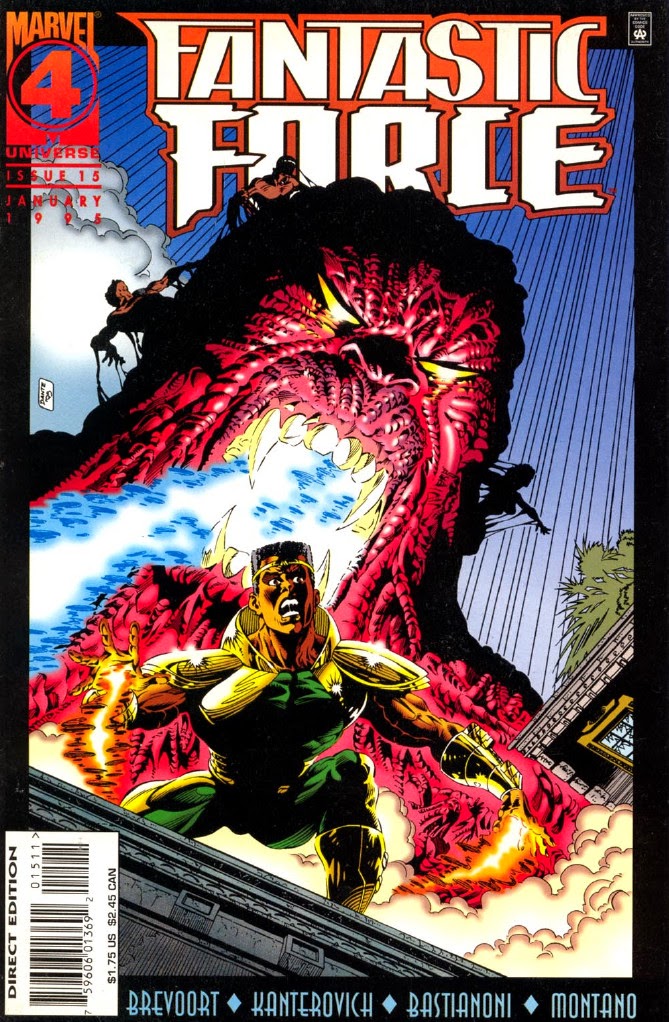
Review: Fantastic Force #15

Fantastic Force #15, Cover Date January 1996
Written by Tom Brevoort & Mike Kanterovich, Penciled by Dante Bastianoni, Inked by Steve Montano

Fantastic Force 15 Cover Vibraxas

Some time ago, I reviewed Fantastic Force #1, and found it to be almost as mediocre as you’d expect a Fantastic Four spin-off circa 1994. Well, because it was the 90’s, the book has lasted all the way to issue #15, a mark that would be the equivalent of 2-3 trade paperbacks in today’s market, aka more than twice as long as a series like this would/should last. Let’s check in on all our favorites: Psi-Lord, Devlor, Vibraxas, and the rest, and see what exciting new adventures they’re up to this month!

Monday, November 10, 2014

Review: Ms. Tree Quarterly #8

Ms. Tree Quarterly, "Maternity Leave," Cover Date Summer, 1992
Written by Max Allan Collins, Penciled and Inked by Terry Beatty

"Who or what is Ms. Tree?" was my reaction when I saw this cover. I've always been more of a Marvel Zombie, but I thought I knew most of DC's books during this time, and I had never heard of any "Ms. Tree." Fortunately, wikipedia exists, and I was able to discover that Ms. Tree is a detective in the classic pulp tradition, who inherited her husband's business after he was murdered by gangsters. By his own admission, Max Allan Collins conceived of the series as a sort of "what if" Mike Hammer married his secretary, Velda, and then was killed?

Tuesday, October 28, 2014

Review: Thunderstrike #4

Thunderstrike #4, “Evil Woman,” Cover Date January 1994
Written by Tom DeFalco, Penciled by Ron Frenz, Inked by Al Milgrom

Thunderstrike 4 Cover


In my previous Thor review, I comp’ed to never having been a big fan of the character’s solo series, emphasizing how at his worst, the character can be a little too similar to Superman with a funny accent. As such, I haven’t read much of Thunderstrike, so a lot of this information is second-hand.

Thunderstrike is Eric Masterson, an architect merged with Thor early in DeFalco’s run, echoing the “Dr. Donald Blake” alter ego of the silver age. Unlike other alter egos (except Captain Mar-Vell), Masterson kept his own personality, including an ex-wife and young son. For a time period, he served as Thor on his own, while Thor was exiled for killing Loki. After Thor came back, Odin created a new mace for Masterson. He debuted as “Thunderstrike,” a slightly less powerful 90’s version of Thor that got his own series in the 90’s.

Saturday, October 4, 2014

Review: NFL Superpro #7

NFL Superpro #7, "All Abuzz," Cover Date April, 1992
Written by Evan Skolnik, Penciled by Jose Delbo, Inked by Mike De Carlo

NFL Superpro 7 Cover


As anyone that even casually follows sports can tell you, it’s been a rough few months for the NFL. In the wake of video footage of Ray Rice knocking out his fiancĂ©e, the NFL and Commissioner Roger Goodell have found themselves under increased media scrutiny, not helped by the fact that players continue to make headlines for beating their children, getting repeated DUIs, receiving drug suspensions and promptly losing thirty pounds, and otherwise behaving as less than ideal role models for children everywhere. Perhaps it’s time for the NFL to turn back to one hero they can always count on: NFL SuperPro!